Fight Odds and MMA Betting in the UK
 Available in US
Table of Contents
- Core UK MMA Betting Markets and Features
- How MMA Betting Grew Into a $10 Billion Market
- Core Bet Types Every MMA Punter Should Know
- MMA Odds Explained: Fractional, Decimal, and Implied Probability
- Fighter Statistics That Actually Move the Line
- UFC and the Promotions Shaping MMA Betting
- Live MMA Betting: Speed, Risk, and AI-Powered Odds
- UK Regulation and Betting Integrity in MMA
- Bankroll Discipline for MMA Betting
- Frequently Asked Questions

I placed my first MMA bet in 2017 on a Saturday night card that started at two in the morning UK time. I was tired, underprepared, and convinced the favourite would cruise through because his record looked better on paper. He got submitted in the first round. I lost forty quid and gained something far more valuable: the realisation that betting on MMA fights requires a completely different toolkit from backing football or horse racing.
Nine years later, the global handle on MMA betting has reached $10.3 billion, per industry estimates, growing 17% year on year. The UK sits among the top five UFC markets worldwide, and the sport’s audience skews younger and more digitally engaged than almost any other betting vertical. Yet most of the guides you will find online read like promotional pamphlets: thin on data, heavy on sign-up links, and silent on the structural forces that actually move the odds.
This guide is different. I have spent years tracking fighter statistics, monitoring line movements, and making enough bad bets to know where the real edges hide and where the market eats careless punters alive. What follows is everything I wish someone had told me before that 2 a.m. card, from the mechanics of each bet type to the AI models now pricing live rounds, from UKGC regulation to the bankroll discipline that separates profitable bettors from recreational ones. No affiliate rankings, no operator cheerleading. Just the data-driven framework you need to bet on MMA fights with your eyes open.
Whether you are placing your first moneyline wager or refining a method-of-victory edge you have been developing for years, this guide covers the ground that the bookmaker pages in the top ten search results consistently ignore. The numbers are sourced, the analysis is practical, and the perspective comes from someone who has been on the wrong side of enough upsets to respect the octagon’s chaos.
Core UK MMA Betting Markets and Features
- The global MMA betting handle reached $10.3 billion in 2024, growing 17% year on year, and the UK ranks among the top five UFC markets worldwide.
- Core bet types include moneyline, method of victory, round betting, and over/under totals, each suited to different levels of matchup conviction.
- Fighter statistics (striking output, takedown defence, reach differential) are the foundation of any data-driven edge, but only when weighted against opposition quality.
- AI-powered in-play odds engines launched in 2026 have transformed live MMA betting, making markets faster and more efficient, and riskier for underprepared punters.
- Stick to UKGC-licensed platforms, set a bankroll with 1–3% unit stakes, and track every bet. Discipline compounds; impulse destroys.
How MMA Betting Grew Into a $10 Billion Market
Five years ago, a sportsbook executive at DraftKings described combat sports as having “evolved from a niche offering to a high-demand category” when announcing their landmark UFC partnership. That was not marketing spin. It was an understatement. The MMA and boxing betting market was valued between $1.5 billion and $3.2 billion in 2024, depending on the methodology, with projections suggesting compound annual growth of 9% to 14% through 2033, according to Verified Market Reports and Fight Matrix estimates. The broader global sports betting market, valued at $32.86 billion in 2025 per Polaris Market Research, provides the rising tide, but MMA has been climbing faster than the water level.
The headline number is the one that caught my attention when I first saw it: a $10.3 billion global handle in 2024, up 17% from the previous year, based on industry reporting by Respect My Region. Handle (the total amount wagered before the bookmaker takes its cut) matters more than revenue figures because it tells you how much money is actually flowing through MMA betting markets. And a 17% annual jump dwarfs the growth rate of established verticals like football or tennis betting.
What is driving this? Three forces working in tandem. First, the UFC’s gross gaming revenue has grown at a compound annual rate exceeding 18% over the past five years, according to Fight Matrix, outpacing nearly every major sport by percentage. Second, the global sports betting infrastructure has expanded through mobile-first platforms, making it trivially easy to wager from a phone at three in the morning when the UFC main card hits UK screens. Third, the demographic tailwind is real: MMA’s core audience skews young, digital, and comfortable with in-play wagering in ways that traditional sports audiences often are not.
None of this means that MMA betting is a guaranteed growth story forever. Market saturation, regulatory tightening, and the cyclical nature of combat sports stars all pose risks. But the trajectory is clear, and for UK punters, it creates both opportunity and complexity: more markets to choose from, more data to process, and more ways to lose money if you are not paying attention.
Where the UK Fits in the Global Picture
The UK gambling industry generated GGY of 16.8 billion pounds in the year to March 2025, a 7.3% increase on the previous period, per Gambling Commission figures. Within that, the remote casino, betting, and bingo sector (the online segment) accounted for 7.8 billion pounds in GGY, representing 46% of the entire market and growing at 13.1%. Online real-event betting specifically produced 596 million pounds in GGY during the final quarter of that reporting period, up 5% year on year. The average monthly count of active online betting accounts stood at 13.5 million.
Those are the macro numbers. The MMA-specific slice does not get broken out in Gambling Commission data, but the contextual clues are strong. The UK ranks among the top five UFC markets globally alongside the United States, Brazil, Canada, and Australia, per PlayToday and InsideSport analysis. When a UFC pay-per-view lands on a Saturday night, typically airing at midnight to 6 a.m. in British time zones, UK bookmakers report significant spikes in handle that track closely with the size of the card’s headliner.
What makes the UK market structurally different from the American one is maturity. British punters have grown up with regulated, competitive bookmaking. Fractional odds are second nature. The UKGC licensing framework means that every platform available to UK bettors operates under compliance obligations that simply do not exist in many other jurisdictions. This creates a floor of consumer protection that MMA bettors in less regulated markets lack entirely.
The flip side of maturity is sophistication. UK bookmakers have been pricing combat sports for decades, boxing first, then MMA as it gained mainstream traction. Their models are sharper, their margins tighter, and the soft lines that once appeared regularly on UFC cards have largely been squeezed out. Finding value in the UK MMA betting market requires more work than it did five years ago, and significantly more than it does on less developed platforms in emerging markets.
Core Bet Types Every MMA Punter Should Know
I remember sitting in a pub explaining MMA bet types to a mate who had only ever backed football accumulators. He was baffled that you could bet not just on who wins, but on how they win, when they win, and whether the fight even reaches a certain round. That range of markets is what makes MMA betting both appealing and dangerous. Appealing because every angle of your analysis can translate into a specific wager, dangerous because complexity invites overconfidence.
The markets below form the foundation. Each one answers a different question about the fight, and each one carries a different risk profile. I will keep the overview tight here. For a granular breakdown of every option available on the board, including niche props and bet builders, the full guide to MMA betting markets goes deeper than any pillar page can.
Moneyline: Picking the Winner
The moneyline is the simplest bet in MMA: pick the fighter you think will win. No conditions, no method requirements. Just the outcome. If your fighter’s hand gets raised, you collect. If it does not, you lose your stake. Every bookmaker lists this market, and for most casual bettors, it is where MMA betting starts and ends.
Simplicity does not mean safety, though. MMA produces upsets at a rate that shocks punters migrating from team sports. A fighter priced at 1/10 in football terms would almost certainly deliver, but in the octagon, a single punch or a surprise submission can end the contest in seconds. I have seen enough heavy favourites face-plant on the canvas to treat any moneyline price below 1/4 with deep suspicion. The payout on those bets rarely justifies the risk, and stacking several short-priced favourites into an accumulator is one of the fastest routes to an empty betting account.
The moneyline is most useful when your analysis points clearly to one fighter winning but you have no strong read on how or when the finish comes. It strips away all the secondary variables and distils your view into the purest possible wager. When you do have an opinion on the method or timing, other markets will usually offer better value for the same level of conviction.
Method of Victory: How the Fight Ends Matters
This market asks you to predict not just who wins, but how they win. The standard options are KO/TKO (which includes punches, kicks, elbows, and any stoppage where the referee intervenes due to strikes), submission (chokes, joint locks, any tap-out or verbal submission), and decision (unanimous, split, or majority). Some bookmakers also list DQ and technical decision as separate outcomes, though these are rare enough that they carry long odds and thin liquidity.
Method of victory is where your matchup analysis earns its keep. A grappler facing a striker, a knockout artist meeting a durable wrestler, a submission specialist against someone with a leaky guard, each stylistic collision shifts the probability distribution across methods in ways that the moneyline cannot capture. If you believe a fighter will win by submission but the bookmaker has priced KO/TKO and submission at similar odds, the market is offering you a gift.
One wrinkle that catches beginners: the difference between three-round and five-round fights. Championship bouts and most main events run five rounds, which gives grapplers and pressure fighters more time to accumulate control and exhaust their opponents. Decision rates climb in five-round fights, and submission finishes often cluster in rounds four and five when fatigue strips away defensive technique. Factor fight length into your method-of-victory assessment. It changes the maths more than most casual bettors realise.
Round Betting and Over/Under Totals
Round betting takes specificity one step further. You can wager on the exact round a fight ends, or you can take the over/under on total rounds, typically set at 1.5 or 2.5 for three-round bouts and 2.5 or 3.5 for five-rounders. The “goes the distance” market is a binary variation: will the fight reach the judges’ scorecards or not?
Over/under 1.5 rounds is the market I use most often in this category. It forces a clean question: does this fight end early or not? When two heavy-handed heavyweights meet, the under 1.5 can offer genuine value because the base rate for first-round finishes in the division is historically high. Conversely, when two technical lightweights with iron chins are matched up, over 2.5 rounds becomes the percentage play.
Exact round bets carry the longest odds and the lowest hit rate. They are speculative by nature. Even if your read on the fight is perfect, timing a finish to a specific five-minute window is partly luck. I treat them as small-stake plays when my conviction on the matchup dynamic is very strong and the odds reflect a genuine mispricing rather than wishful thinking. If you are new to MMA betting, start with over/under totals before graduating to exact rounds. The learning curve is gentler and the bankroll damage from a losing run is more manageable.
MMA Odds Explained: Fractional, Decimal, and Implied Probability
The first time I tried converting American odds to fractional on the fly (at 3 a.m. while a walkout was happening), I realised that understanding odds formats is not optional, it is infrastructure. Every pricing decision you make as a bettor depends on reading the number correctly and knowing what it implies about probability.
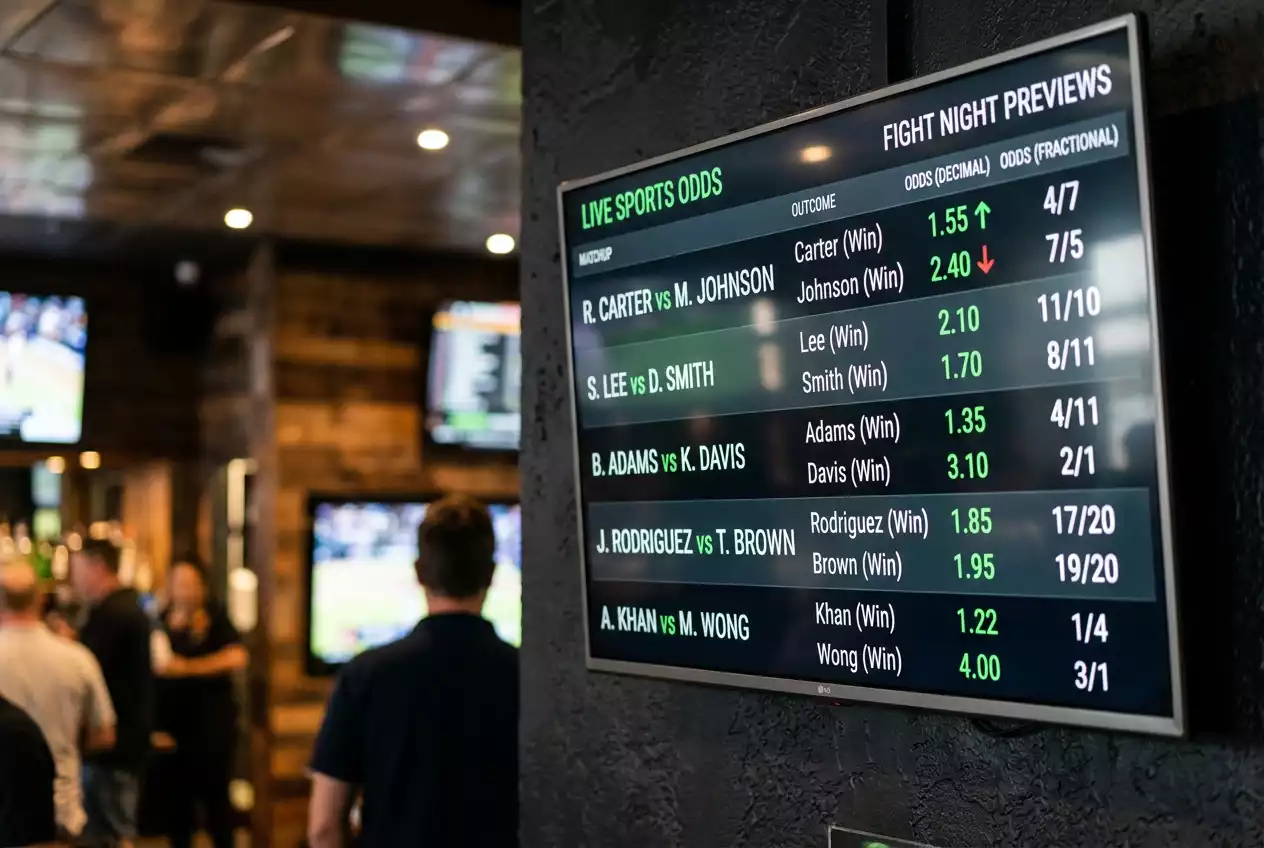
UK bookmakers default to fractional odds, which express your potential profit relative to your stake. A fighter listed at 3/1 returns three pounds of profit for every pound wagered, plus your original stake back, four pounds total. A favourite at 1/3 returns 33 pence of profit per pound staked. The first number is always the potential profit; the second is the stake required. Fractional odds are intuitive once you internalise them, but they make quick mental calculations harder when the numbers get uneven. Try computing 11/8 in your head while the card is live.
Decimal odds, used by most online platforms as the default display, express the total return per unit staked. A price of 4.00 means a one-pound bet returns four pounds total (three pounds profit plus your stake). A favourite at 1.33 returns 1.33 pounds per pound wagered. The conversion is straightforward: decimal odds equal fractional profit divided by stake, plus one. So 3/1 becomes 4.00, and 1/3 becomes approximately 1.33.
Implied probability is the layer underneath both formats, and it is the number that actually matters for finding value. To convert decimal odds into implied probability, divide one by the decimal price and multiply by 100. A fighter priced at 2.50 implies a 40% chance of winning (1 / 2.50 = 0.40). A favourite at 1.40 implies roughly 71.4%. When you see those percentages, you can compare them against your own assessment of the fight and identify where your view diverges from the market’s.
| Fractional | Decimal | Implied Probability | What It Means |
|---|---|---|---|
| 1/4 | 1.25 | 80% | Heavy favourite, low payout, high expected win rate |
| 4/6 | 1.67 | 60% | Moderate favourite |
| Evens (1/1) | 2.00 | 50% | Coin-flip pricing |
| 2/1 | 3.00 | 33.3% | Clear underdog |
| 5/1 | 6.00 | 16.7% | Long shot |
One critical detail: the bookmaker’s margin. If you add up the implied probabilities of all outcomes in a market, the total will exceed 100%. That excess, called the overround, is how the bookmaker guarantees profit regardless of the result. In MMA moneyline markets, overrounds typically sit between 5% and 10%, though they can widen on lower-profile cards where the bookmaker wants extra protection against thin liquidity. For a detailed walkthrough of how to spot and account for margin across all formats, the full odds explanation covers the mechanics and practical examples in depth.
Fighter Statistics That Actually Move the Line
There was a period when I bet on MMA based entirely on watching fights and forming gut impressions. My strike rate was mediocre. The day I started building spreadsheets (tracking significant strikes per minute, takedown defence percentages, and submission attempt rates), my results improved measurably. Not because statistics replace watching tape, but because they anchor your subjective impressions to something verifiable.
MMA generates a rich statistical profile for every fighter. More than 300 million people follow the sport globally, and the UFC alone broadcasts to over 210 countries, reaching roughly 950 million households, per UFC and Paramount data. That scale produces data volumes that were unthinkable a decade ago. The UFC’s roughly 700-million-strong global fan base, with around 330 million social media followers across platforms per TKO Group Holdings figures, creates demand for increasingly granular performance metrics.
The statistics that matter most for betting fall into three clusters. First, striking output and accuracy: significant strikes landed per minute, significant striking accuracy (percentage of strikes that land), and significant strikes absorbed per minute. A fighter who lands 6.5 significant strikes per minute at 55% accuracy while absorbing only 2.8 is operating at an elite level, and that differential tells you far more than a win-loss record ever could.

Second, grappling metrics: takedown accuracy, takedown defence, and average control time per fight. A wrestler who completes takedowns at 45% accuracy against a fighter with 60% takedown defence creates a specific dynamic that influences everything from method of victory to round totals. These numbers help you model what happens when styles collide.
Third, physical measurables: reach differential and stance matchup data. An orthodox fighter with a four-inch reach advantage against a southpaw operates with structural leverage that affects striking exchanges. Reach matters less in grappling-heavy matchups but becomes a significant factor in stand-up battles, particularly at lighter weight classes where technical precision dominates over raw power.
Round markets combine how likely a finish is with when it tends to come. Grinding grapplers and heavy hitters finish early (skew early); volume strikers and cardio machines drag fights late. „Under 1.5 rounds” is roughly a first-round finish; „goes the distance” is a decision. Five-round main events push more fights the distance and cluster submissions in the championship rounds. Fair odds carry no margin — compare with the book. Informational only.
Favourites are systematically overbet in the UFC, so the underdog side is where value tends to hide — but not evenly. Small and medium dogs (roughly +130 to +200) win often enough to be near fair or slightly profitable, while big longshots are almost always overpriced. These are historical averages across many fights, not a read on one matchup — use them as a sanity check on the price, then adjust for the actual styles. Informational only.
The mistake most novice bettors make is looking at stats in isolation. A high knockout rate means nothing if the fighter has only faced opposition with weak chins. A strong takedown defence percentage loses context if it was built against fighters who rarely shoot. Always weight stats against the quality of opposition and the recency of the sample. A framework for turning raw numbers into actionable betting edges is exactly what the MMA betting strategy guide is designed to provide.
Key Metrics for MMA Betting Analysis
Significant strikes landed per minute: measures offensive output on the feet. Significant striking accuracy: percentage of strikes that connect. Significant strikes absorbed per minute: indicates defensive skill and durability. Takedown accuracy: shows grappling offensive effectiveness. Takedown defence: reveals vulnerability to wrestling-based opponents. Average control time: total mat time per fight, critical for decision outcomes. Reach differential: structural advantage or disadvantage in the striking range.
UFC and the Promotions Shaping MMA Betting
When Paramount’s chairman David Ellison called the UFC “a global sports powerhouse with extraordinary global recognition, scale, and cultural impact” while announcing a $7.7 billion, seven-year media rights deal in 2025, he was describing the economic reality that every MMA bettor operates within. The UFC is not just the biggest promotion. It is the gravitational centre around which the entire MMA betting ecosystem orbits.
The numbers back it up. UFC posted annual revenue of approximately $1.502 billion in 2025 with an EBITDA margin of 57%, according to SponsorUnited and TKO Group Holdings data. Sponsorship revenue alone hit $314.3 million that year, a 25% jump from 2024. The Paramount media deal, worth roughly $1.1 billion annually when it took effect in 2026, ensures that UFC content floods screens globally, and where eyeballs go, betting handle follows.
For UK punters, the UFC’s dominance means three practical things. First, market depth: bookmakers price every fight on every UFC card, from the opening preliminary bout to the main event. Liquidity is consistently strong, which means better odds and tighter spreads compared to smaller promotions. Second, data availability: the UFC’s official data partnerships feed real-time statistics to odds compilers, creating markets that are well-informed but also efficient, with soft lines closing quickly. Third, media saturation: the sheer volume of UFC content drives betting volume, which in turn drives more content, creating a flywheel that keeps MMA wagering growing.

But the UFC is not the whole picture. The global MMA event landscape has expanded from roughly 100 to 110 major events in 2020 to a projected 180 to 200 in 2025, per PTF Lab analysis. The total MMA industry revenue grew from approximately $1.2 billion to more than $2.2 billion over the same period. PFL (Professional Fighters League) crossed $100 million in revenue in 2024 for the first time. ONE Championship’s revenue trajectory climbed from $57 million in 2020 to a projected $200 million in 2025.
Closer to home, Cage Warriors – the largest British and Irish MMA promotion, founded in 2001 – runs events across the UK and Europe. Cage Warriors has produced multiple future UFC champions, and its cards increasingly attract betting interest from UK bookmakers. The promotion operates on a smaller scale, which means softer odds, thinner markets, and occasionally, genuine value for bettors who follow the regional scene closely enough to spot what the wider market misses.
The practical takeaway: while the UFC will anchor most of your MMA betting activity, keeping an eye on PFL, Cage Warriors, and ONE Championship gives you access to markets where the odds compilers are less sharp and the information asymmetry tilts slightly in your favour.
Live MMA Betting: Speed, Risk, and AI-Powered Odds
The round ends. A fighter walks back to his corner with a swelling eye and heavy breathing. In the fifteen seconds before round two starts, the in-play odds shift – sometimes violently. That window is where live MMA betting lives, and it is the fastest-growing segment of combat sports wagering.
In-play betting already accounts for 60% to 80% of total wagering turnover across European sportsbooks, according to JMP Securities data reported via Nasdaq. In the United States, the figure sits between 30% and 40%, but analysts project compound annual growth of 25% for in-play markets through the current decade. MMA has historically lagged behind football and tennis in live betting sophistication – the speed of action inside the cage made accurate real-time modelling extraordinarily difficult. That changed in January 2026.
SWA and Sportradar launched the first industry-wide in-play betting model for MMA, using official data feeds from both UFC and PFL, per G3 Newswire reporting. SWA’s CEO, Caspar Hobbs, described the technology in direct terms: their science team developed “data driven bottom-up generative AI modelling that outputs tens of thousands of potential outcomes every second, pricing each one in real time.” The model enables micro-parlays and social betting opportunities that were previously impossible in combat sports because the action was too fast and too complex for traditional odds compilation.
What does this mean for you as a UK punter? Live MMA odds are now more responsive, more granular, and more accurate than they were even twelve months ago. The AI models ingest strike counts, takedown attempts, control time, and positional data between rounds – and sometimes within rounds – to update prices continuously. If a fighter dominates round one with a flurry of significant strikes but fails to secure the finish, the model adjusts the moneyline, the method of victory odds, and the round totals simultaneously.
The risk for bettors is that responsiveness cuts both ways. AI-powered odds engines eliminate the slow-moving lines that experienced live bettors used to exploit. Price discrepancies close in seconds rather than minutes. Latency – the delay between what you see on screen and what has actually happened in the cage – becomes a material disadvantage, especially on mobile connections during peak traffic. If you are watching a fight on a stream that runs fifteen seconds behind the live feed, you are betting on stale information while the market has already moved.
Live MMA betting rewards preparation and punishes impulse. The best in-play bettors I know decide before the fight starts which scenarios would trigger a live bet. They know their entry price. They know their exit conditions. They do not chase. For a deep dive into in-play strategy, round-by-round market mechanics, and cash-out timing, the dedicated live MMA betting guide covers the territory that this section can only outline.
UK Regulation and Betting Integrity in MMA
I get asked about match-fixing more often than about any other topic in MMA betting. People hear about a suspicious result, see a headline about an investigation, and wonder whether the whole sport is compromised. The answer is more nuanced than either the alarmists or the dismissers would have you believe – and the data tells a story that is worth understanding before you place a single pound on a fight.
Start with the regulatory framework. Every bookmaker legally operating in the UK holds a licence from the UK Gambling Commission, which enforces the Gambling Act 2005. This is not a rubber stamp. The UKGC conducted 9,700 compliance actions in the 2024/2025 reporting year – more than double the 4,200 recorded in 2023/2024, per FTI Consulting analysis of the UKGC Annual Report. Between 2025 and 2026, the Commission issued 741 cease-and-desist notices and referred nearly 398,000 illegal URLs to search engines, according to iGaming Business reporting on a speech by Tim Miller. The enforcement apparatus is real, active, and expanding.

On the integrity front, the International Betting Integrity Association recorded 300 suspicious betting alerts globally in 2025 – a 29% increase on the 232 alerts in 2024 and the highest annual figure on record, per the IBIA 2025 Sports Betting Integrity Report. Of those, 54 matches were confirmed as corrupted using IBIA data, resulting in sanctions against 24 individuals across five sports. MMA is not immune: in the first quarter of 2026, IBIA logged one alert specifically flagged to MMA in North America.
The UFC takes this seriously – or at least, it projects seriousness forcefully. Dana White has stated publicly that the organisation monitors every fight through IC360, calling them “the best in the business” at detecting irregular betting patterns. His warning to fighters was characteristically blunt: involvement in fixing would lead the UFC to pursue criminal prosecution. Whether you find that reassuring or performative, the practical outcome is that UFC-level MMA has multiple overlapping layers of integrity monitoring – IBIA at the operator level, IC360 at the promotion level, and the UKGC at the regulatory level.
For UK bettors, the implication is straightforward: stick to UKGC-licensed platforms. If a fight result is later overturned or an integrity investigation reveals suspicious activity, licensed operators have clear processes for handling affected bets. Unlicensed offshore sites operating outside the UKGC framework offer no such protection, and using them exposes you to risks that go well beyond losing a bet. The full breakdown of UK MMA betting regulation covers the Gambling Act, recent reforms including stake limits and affordability checks, and the responsible gambling tools available on licensed platforms.
Bankroll Discipline for MMA Betting
Here is an uncomfortable truth I learned the hard way: my worst losing streak in MMA betting was not caused by bad analysis. The picks were sound. The matchup reads held up. I lost because I sized my bets poorly after a winning run and then compounded the damage by chasing losses across the back end of a fight card. Sound familiar?
MMA punishes undisciplined staking more harshly than most sports. A horse racing punter can spread risk across dozens of meetings per week. An MMA bettor gets one card, twelve or thirteen fights, and might only identify three or four with a genuine edge. That means smaller sample sizes, higher variance per session, and a much steeper cost for oversizing a position on a single fight that goes wrong.
The flat-stake starting point: Risk the same fixed percentage of your bankroll on every bet, regardless of confidence level. Most disciplined MMA bettors I know use between 1% and 3% per wager. On a 500-pound bankroll, that means 5 to 15 pounds per bet. It sounds small. It is supposed to sound small. The point is surviving the inevitable cold streaks long enough for your edge to compound – and MMA produces cold streaks that would make a football bettor weep.
Beyond flat stakes, the Kelly Criterion offers a mathematically optimal approach to bet sizing based on your estimated edge and the odds available. The full formula requires you to assign a probability to each outcome, which in MMA is harder than it sounds – but even a rough application of half-Kelly (using half the recommended stake) imposes useful discipline. The percentage-of-bankroll method sits between flat stakes and Kelly: you risk a set percentage of your current bankroll, so your stakes shrink automatically during losing runs and grow during winning ones.
Session limits matter specifically for MMA because fight cards are concentrated events. Unlike a cricket test spread across five days or a tennis slam running two weeks, a UFC card compresses twelve fights into a few hours. The temptation to increase stakes as the night wears on – especially after an early loss – is intense and almost always counterproductive. Set a session cap before the first fight starts. When you hit it, stop. No exceptions. The card will be there next week.
Track everything. Every bet, every stake, every return, every fight. A spreadsheet takes five minutes per card. Over three months, the data will tell you where your edge actually lives – which promotions, which weight classes, which market types. Without tracking, you are guessing about your own performance, and guessing is what the bookmaker wants you to do.
Frequently Asked Questions
Is betting on MMA fights legal in the UK?
Yes. Betting on MMA fights is fully legal in the United Kingdom under the Gambling Act 2005, provided you use a bookmaker licensed by the UK Gambling Commission. The UKGC regulates all forms of sports betting, including combat sports, and requires operators to meet strict standards for consumer protection, responsible gambling, and financial transparency. Using an unlicensed or offshore operator removes those protections entirely – and while placing a bet on an unlicensed site is not a criminal offence for the bettor, you have no recourse if something goes wrong with your account, your funds, or a disputed result.
What types of bets can you place on MMA fights?
The core markets available on most UK platforms include moneyline (picking the winner), method of victory (KO/TKO, submission, or decision), round betting (exact round finish or over/under totals), and goes-the-distance bets. Beyond these, major bookmakers offer accumulator and parlay options across a fight card, futures markets on title fights and tournaments, and proposition bets covering fighter-specific metrics such as significant strikes, takedowns, and knockdowns. Bet builder tools allow you to combine multiple selections within a single fight into one custom wager. The range of available markets widens significantly for UFC main events compared to preliminary card bouts or smaller promotions.
How do MMA betting odds work in fractional and decimal formats?
Fractional odds, the traditional UK format, show your potential profit relative to your stake. A fighter at 3/1 returns three pounds profit for every pound wagered, plus your original stake. Decimal odds, the default on most online platforms, show the total return per unit staked – so the same price appears as 4.00 in decimal format. To convert fractional to decimal, divide the first number by the second and add one. Both formats express the same underlying implied probability: divide one by the decimal odds and multiply by 100 to see the bookmaker’s estimated win chance. A price of 2.50 implies a 40% probability. The total implied probability across all outcomes in a market will exceed 100% – that excess is the bookmaker’s margin.
What happens to my bet if a fight is cancelled or a fighter pulls out?
If a fight is cancelled before it begins – typically due to injury, illness, or a failed weight cut – your bet will usually be voided and your stake returned. However, the exact rules vary between bookmakers, so checking the operator’s terms and conditions for combat sports is essential before placing your wager. If a fight starts but is stopped and declared a no contest (due to an accidental foul, for example), most bookmakers void all bets on that fight, though some may settle method-of-victory bets differently depending on the specific circumstances. In accumulators, a voided fight typically becomes a “dead leg,” and the accumulator is recalculated as if that selection did not exist – reducing the overall odds but not invalidating the entire bet.
How is live (in-play) betting different for MMA compared to other sports?
Live MMA betting operates in compressed time windows. Unlike football, where a match unfolds over 90 minutes with gradual momentum shifts, an MMA fight can change completely in a single exchange. In-play odds update between rounds and sometimes within rounds, driven by AI models that process strike counts, takedown data, and positional control in real time. The speed of price movement is significantly faster than in team sports, and latency – any delay between the live action and your viewing feed – can mean you are betting on outdated information. Cash-out options are available on many UK platforms during live fights, but the prices offered reflect the rapid shifts in real-time probability, and the margin on cash-out tends to be wider than on pre-fight markets.
What should beginners know before placing their first MMA bet?
Start with three fundamentals. First, only use UKGC-licensed platforms – this is non-negotiable for consumer protection. Second, begin with moneyline bets on fighters you have actually watched compete, not just names you recognise from social media. Watching at least two or three recent bouts for each fighter gives you a basic read on their style, tendencies, and current form that no stat sheet can fully replace. Third, set a bankroll and a staking plan before your first bet. Decide how much you are willing to lose over a defined period, divide that into unit stakes of 1% to 3% per bet, and track every wager. Treating the early phase as a learning exercise rather than a profit-seeking venture will save you money and build habits that compound over time.
How do I choose a safe and UKGC-licensed MMA betting site?
The single most important criterion is a valid UKGC licence, which you can verify on the Gambling Commission’s public register. Beyond that, evaluate the platform’s MMA market depth – does it cover UFC prelims, non-UFC promotions like PFL and Cage Warriors, and prop bet markets, or only headline fights? Check whether live betting is available for MMA events and whether the cash-out feature works during fights. Look at the responsible gambling tools on offer: deposit limits, loss limits, reality checks, session timers, and self-exclusion options should all be accessible and easy to configure. Finally, read the specific settlement rules for combat sports – how the operator handles void bets, no contests, and weight misses varies, and understanding these terms before you bet prevents unpleasant surprises after a result.
Created by the ”Betting on mma Fights” editorial team.