Weigh-In Signals and MMA Weight Cuts Betting
 Available in US
A few years back, I watched a fighter step on the scale looking like he’d aged ten years overnight. Sunken cheeks, hollow eyes, visibly shaking as the official read the number. He made weight – barely – and the next night, he got knocked out in the first round by a fighter he’d beaten handily twelve months earlier. The odds hadn’t moved. I’d bet the favourite. And I learned the hard way that the number on the scale tells you one thing, but the body standing behind it tells you everything.
Severe Weight Depletion and Fighter Performance Metrics
Weight cutting in MMA is the practice of rapidly dehydrating to meet a contracted weight class limit, then rehydrating before the fight. Most fighters compete at a weight class well below their natural walking-around weight – a lightweight who fights at 70 kg might walk around at 82-85 kg, shedding 12-15 kg of water weight in the final days before weigh-in.
The physiological toll is severe and well-documented. Rapid dehydration reduces plasma volume, which impairs cardiovascular output – the fighter’s heart has to work harder to deliver oxygen to muscles. Cognitive function degrades: reaction time slows, decision-making quality drops, and the ability to absorb strikes diminishes because the cerebrospinal fluid that cushions the brain is partially depleted. A fighter who’s cut heavily has a compromised chin, diminished cardio, and slower reflexes, even after 24-30 hours of rehydration.
The rehydration window is the critical variable. UFC fighters typically weigh in on Friday for a Saturday fight, giving them roughly 30 hours to rehydrate and recover. Research consistently shows that full recovery from a severe cut requires 48-72 hours – meaning most fighters enter the cage in a partially recovered state. The betting market treats this as background noise. It shouldn’t be.
Visual and Statistical Cues From Weigh-In Day
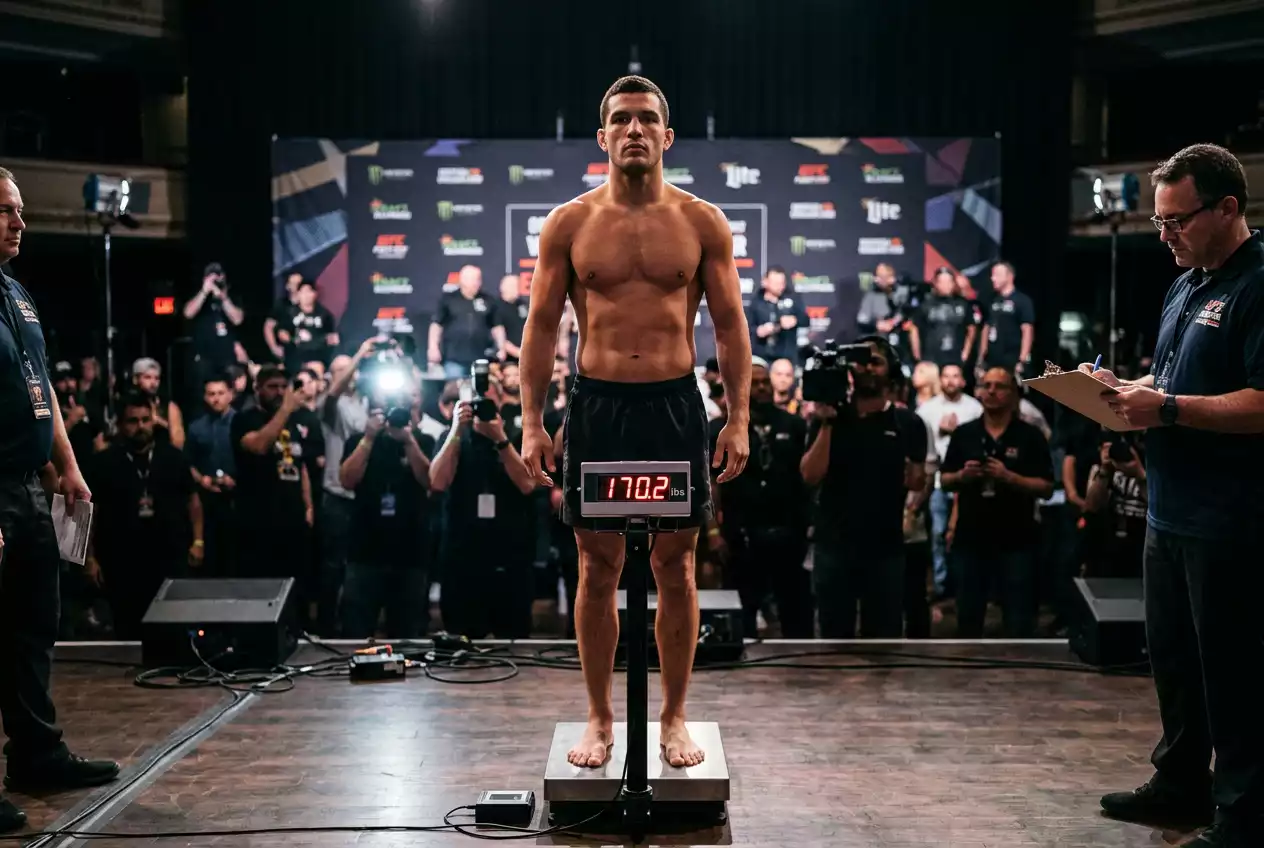
Weigh-in footage is the most underused analytical tool in MMA betting. UFC’s global audience spans over 300 million fans across 210 countries and territories, per Paramount data, and the ceremonial weigh-in is streamed live for every event. Yet most bettors watch it for the staredowns, not the signals.
Here’s what I look for. Facial structure: sunken cheekbones and pronounced eye sockets indicate severe dehydration. Body composition: a fighter who appears drawn, flat-muscled, and visibly smaller than their usual frame has likely pushed the cut to its limit. Behaviour: trembling, difficulty standing still, and slow responses to the official’s instructions suggest neurological impairment from dehydration.
Compare the weigh-in appearance to the fighter’s previous weigh-ins at the same weight. If a fighter who normally looks comfortable at 66 kg suddenly appears gaunt and drained, something has changed – either they’ve put on significant muscle between camps, their body composition has shifted with age, or their cutting protocol has gone wrong. Any of those scenarios degrades fight-night performance.
The statistical cue I track is late weight misses during a fighter’s career. A fighter who has missed weight previously is at elevated risk of a difficult cut in future bouts, and the performance data supports this: fighters who struggled to make weight in the past show statistically lower striking output and higher finish rates against them in subsequent fights at the same weight class.
When Fighters Miss Weight: Odds Shifts and Rule Changes
A missed weight – when a fighter steps on the scale above the contracted limit – triggers an immediate cascade of consequences. The fight may proceed at a catchweight, or the opponent may refuse the bout entirely. If it goes ahead, the fighter who missed weight typically forfeits 20-30% of their purse to their opponent and may lose the ability to win a title (if it was a championship fight).
The betting implications are significant. Most operators will relist the fight with adjusted odds reflecting the missed weight, and the adjustment is almost always against the fighter who missed. The logic is sound: a fighter who couldn’t make weight is physically compromised. But the magnitude of the odds shift varies wildly between operators and often doesn’t accurately reflect the actual performance impact.
In my experience, the market overreacts to missed weights in some scenarios and underreacts in others. When a fighter misses by half a pound, the physical impact is negligible – they saved themselves the last painful hour of cutting, and they’ll enter the cage feeling better than if they’d struggled to make the limit. The odds shift in that scenario often creates value on the fighter who missed. When a fighter misses by three or more pounds, the situation is genuinely concerning: it suggests a fundamental problem with their cut, their discipline, or their body’s ability to make the weight class.
The global MMA event calendar has grown from approximately 100 major events in 2020 to nearly 200 projected for 2025, per PTF Lab data. More events means more weigh-ins, more missed weights, and more opportunities to apply this analysis. I track every missed weight across UFC, PFL, and Cage Warriors cards and map the outcomes against the post-miss odds adjustment. The pattern is clear: small misses are overpenalised, large misses are appropriately penalised, and the betting edge sits in knowing which is which.
Divisions Where Weight Cuts Distort Lines the Most
Not all weight classes suffer equally from cutting culture. The divisions where the gap between fighting weight and natural weight is largest produce the most distorted betting lines around weigh-in day.
Bantamweight (61 kg) and featherweight (66 kg) are historically the worst-affected divisions for weight cut complications. Fighters at these weights are often natural lightweights or even welterweights cutting enormous percentages of their body weight to gain a size advantage. The physical toll is proportionally greater at lower body weights because there’s less mass to absorb the dehydration. A 70 kg fighter cutting to 61 kg is losing 13% of their body weight in water – a cut that leaves lasting performance effects even with optimal rehydration.
Heavyweight is the outlier in the other direction. With no upper limit (the class spans 93-120 kg), most heavyweights don’t cut weight at all or cut minimally. Weigh-in day tells you almost nothing about a heavyweight’s physical readiness, which means the visual and statistical cues I rely on at lower weights are irrelevant. Heavyweight betting requires a completely different analytical framework – one built around power, chin durability, and cardio rather than weight management.
Women’s divisions present an additional consideration. Female fighters typically carry lower body fat percentages than their male counterparts at equivalent relative weights, which means the available water weight for cutting is smaller. A difficult cut at women’s strawweight (52 kg) can produce more dramatic performance effects than a proportionally equivalent cut at men’s lightweight, because the margins are tighter and the recovery window is the same.
How do weight cuts affect MMA betting odds before a fight?
Weight cuts primarily affect odds through two mechanisms. First, weigh-in footage and reports of difficult cuts circulate on social media and MMA news sites, prompting public money to shift toward the fighter who appeared healthier at weigh-in. Second, a missed weight triggers a formal odds adjustment by the bookmaker, typically lengthening the odds on the fighter who missed. The magnitude of both effects varies – subtle visual cues may move the line by a few percentage points, while a significant missed weight can shift odds substantially.
Should you always fade a fighter who missed weight?
No. The severity of the miss matters enormously. A fighter who missed by half a pound likely experienced a negligible physical impact and may actually feel fresher on fight night than one who struggled to make the exact limit. A fighter who missed by two or more pounds has a genuine physical disadvantage worth factoring into your bet. Context also matters: why they missed (poor camp discipline versus a body that’s outgrown the weight class), their history of missing weight, and how their opponent adjusts to the catchweight situation all influence whether fading the miss is the correct play.
Published by the Betting on mma Fights team.